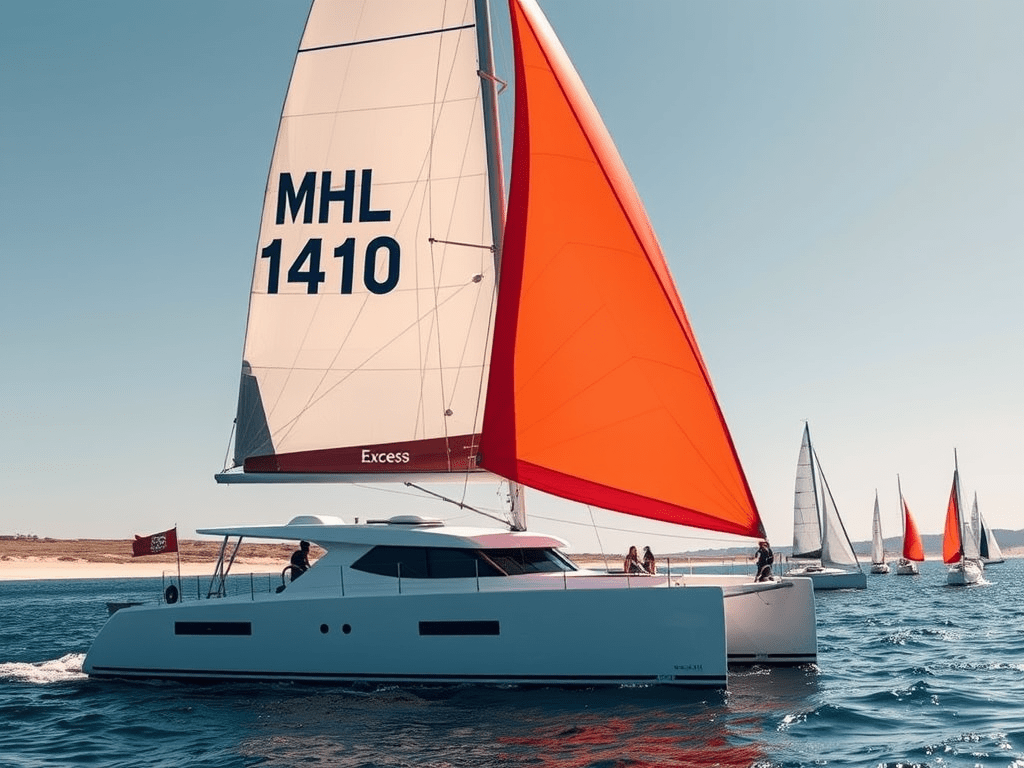
For the 2026 sailing season, we’re planning our route around a few races. Similar to buying the boat, as a boat owner, it was now my problem to handle these details that had been magically handled by the owners of the other boats I raced on.
I went from being the smart one with friends who had race boats, to a stupid owner that now needs to manage all the details, including:
- Where/when are the races we could compete in (see here)
- What are the changes to the boat we’d need to be competitive (coming soon)
- What insurance do we need? (Check your insurance policy, as racing may already be covered, depending on the length of the race.)
- How do we get a handicap rating? (see below)
- How do we get a sail number? (see below)
I’ll keep this blog focused on the certification process and getting a sail number.
Handicap Rating
There are several handicap rating systems for monohulls (ORC, IRC, PHRF), and at least two for multihulls. Each has a different formula for applying the handicap.
- MOCRA – Total Corrected Time-based handicap,
- ORC Multihulls – an extension of the ORC rating system for monohulls, using more complex ratings. ORC handicaps are expressed as Time Allowances in s/NM for different wind conditions for a complete variety of wind angles.
Which Rating Should You Get
The organizers of each race will post the Sailing Instructions (SI) and a Notice of Race (NOR), which specify the classes (monohull, multihull, …), the rating system used, and many other important details, including the race course and length. Races managed by a charter fleet may not have a NOR and likely won’t require a handicap certificate or sail numbers. For the races we chose for the 2026 Mediterranean season, they all require a MOCRA rating. This includes the CNSM regattas and the Rolex Middle Sea Race. The Tre Golfi Multihull Trophy race required an ORCmh rating, but we couldn’t fit it in our plans anyway.
Getting a MOCRA Rating
The MOCRA rating provides a Time Correction Factor (TCF), calculated to three decimal places for fairness. The elapsed time of the boat’s race is multiplied by the TCF rating to produce a corrected time.
[Corrected Time] = [Elapsed Time] * [TCF]
The TCF is based on many measurements, many of which apply to all boats of the same year/make/model, while others are unique to each sail plan and boat commissioning, such as weight, propeller, and other details.
A lower TCF rating reflects a slower boat, giving it more time on the course. A higher TCF rating indicates a faster boat, which must finish ahead of the slower one. Or, put more simply, if two boats cross at the same time, the lower TCF-rated boat would win.
As an example, in the hypothetical race below, a 5,800kg, carbon daggerboard Dazcat 1195 crossed the finish line first. Two 12,800kg performance-cruising Excess 14’s completed the race 1 hour and 10 minutes after the Dazcat, with less than 3 minutes between them. Because of subtle differences between the two Excess 14’s, they had slightly different TCF ratings. Once the TCF rating was applied, The Dogz House was within 5 minutes of Suenos, and Tiyani came in third, 1 second behind. This was a much closer race than the finish line reflected.
| Boat | Make/Model | Elapsed | Elapsed Delta | TCF | Corrected | Elapsed Delta |
| Suenos | Dazcat 1195 | 7:32:00 | 1.189 | 8:57:26 | ||
| The Dogz House | Excess 14 | 8:42:18 | 1:10:18 | 1.039 | 9:02:40 | 0:05:15 |
| Tiyani | Excess 14 | 8:45:52 | 1:13:52 | 1.032 | 9:06:45 | 0:05:16 |
Some races where Excess 14’s completed:
The Steps to Getting a MOCRA Certificate
The place to start is the MOCRA website, which includes:
- Becominga MOCRA member: a pre-req to getting a certificate
- Getting a sail number: see below
- Completing the measurements for your boat, where all the details are captured
Becoming a MOCRA Member
Becoming a MOCRA member was pretty easy, and a small “boat unit” (GPB 75 for the 2026 season) for a 12-15m boat like the Excess 13 and 14. Payments were also easy via PayPal, credit cards, or IBAN/SWIFT payments via WISE or other payment processors. While MOCRA is based in the UK, 40% of their members are international, so don’t let the UK discussions discourage you. Just confirm what handicap rating system the races you want to participate in require.
The Join MOCRA page describes the process of assembling a personal profile photo, a photo of your boat, and filling out a member form. Nothing here is difficult to assemble. Just email the contact listed on the page. Andreas was really helpful with a litany of questions I had. Which I hope this article will answer for others.
Getting a Sail Number
This one was a little more confusing. How do you get a unique sail number? And, what country issues the sail number? The sail number is associated with the boat, not specific to the citizenship of the owner(s). Which is important when they diverge.
The Racing Rules of Sailing have a section for Identification on sails, which is used by MOCRA. The RRS lists the details on size, font, and which sails must be numbered. It also lists the country’s national letters, denoting the country’s national authority.
As an example, if your boat is registered in the U S, you’d get your sail number through the US Sailing: Sail Number Application. UK-registered boats would request through the RYA: Sail Number Application. Irish boats would use Irish Sailing > Sail Numbers. Suffice to say, check if the country you’re registered under is listed under Section G of the Racing Rules of Sailing.
What if your registering country isn’t listed, or they don’t have a sail registration process?
For insurance and tax reasons, we chose to register Hull Yeah under the Marshal Islands flag. I’ll defer the details to this great post from the Wynns, who covered this topic really well: Why We Did NOT Register Our Boat In The USA. Others have boats registered in landlocked countries, like Austria. In these cases, there is no sanctioning body for racing, unique to that country. If your registering country isn’t listed, or you don’t have a sanctioning body, you need to make up your own number.
After talking with Andreas and Simon from MOCRA, the Sail Number process can use the following formula:
[IOC three-letter code] [Manufacturer Model Reference][Last two HIN digits]
Start by looking up your country under the list of IOC country codes. For example, the IOC code for the Marshall Islands is MHL.
The manufacturer’s model number might be 14 for an Excess 14, or 13 for an Excess 11, or 45 for an Outremer 45.
The hull identification number could be simple if you’re under 100. Section G states you must limit the number to four digits. If you’re hull 109 of an Excess 14, you might try 4109. When in doubt, consult the MOCRA folks to see what they may already have registered.
For our Marshall Islands-registered Excess 14 hull #10, we registered MHL 1410.
Following the applicable sections of RRS Rule 77, Appendix G, the sail number will be placed on both sides of our main, jib, code 0, and gennaker. I started this process over the winter, when the sails were getting serviced, so I had North Sails apply the numbers. They’re just sticky-backed tape, so you can install them yourself, just like you might do for sail repairs.
Here’s additional info on Issuing and Changing Sail Numbers.
Check the Safety Equipment for Racing Requirements
Each NOR will specify the safety requirements they’ll require. Many use the World Sailing – Offshore Special Regulations. The NOR will specify which category is applicable and what’s required for your boat to qualify. If you’re new to racing, a new owner that’s now the responsible party, or new to racing multihulls, the documents provide a great sense of what you’re getting into. most of them are great additions to have aboard, even for cruising.
I mentioned this before taking the measurements, as it may affect the measurements and weights.
Phone or Make a Friend
While racing is competitive, you won’t find a better group of people that are wanting to help. Check the MOCRA racing site for boats similar to yours. Using the power of the internet, reach out to them and ask what they’ve done to stay safe and competitive. You’ll likely be surprised by how many details they’re willing to share. Great racers like the competition; it ups everyone’s game.
Completing the Measurements
This is where the majority of the work comes in. Spoiler Alert: You’ll need to weigh your boat, which you can do when you haul out for seasonal antifouling. So, plan for this one. If you won’t have a chance, contact the MOCRA folks. They might be willing to use a similar boat’s details for your make/model. If you don’t measure or weigh your boat, you could get protested, depending on how competitive your class is and how well you do. A good problem to have, compared to not racing at all.
The MOCRA Racing section provides a good overview. Once reviewed, see if someone else has registered a boat like yours under the MOCRA Rating. Find the names of the boats that are the same model, then look under the [Certificates] menu for the boats’ certificate details. For example, MOCRA Rating – The Dogz House is an Excess 14. It will provide a good baseline. However, your measurements or weights may vary. Gary, the owner of The Dogz House, said he’s making some changes, and his 2025 TCF rating of 1.039 may change. When you submit your MOCRA Membership, chat with the folks to let them know what you’ll be registering. They may have a manufactureres template all ready to start. You can then customize your specifics.
For instance, Hull Yeah has 1,200Ah of batteries, 3 AC units, 100m of 10mm chain, a 35kg anchor, and a 7kw, 272 kg (600 lbs) generator. Which is about the same weight as a second 300-liter water tank. (Yes, we really like our AC, no judging). All of this, your sails and other factors, will be calculated into your TCF rating.
As you measure and weigh the boat, be sure to note its condition, as you’ll be racing. If you have two water tanks and a water maker, you’ll likely want to fill only one of them. You’ll probably want to leave the dinghy behind, as you’ll likely need a life raft. You’ll also want to check the safety requirements
Once you have captured all the details, send them to the MOCRA contacts, along with the MOCRA certificate payment. It’s another GBP 50, depending on the size of your boat.
The MOCRA Rating Certificate is administered by MOCRA volunteers, so please be patient with response times. I’ve found them really helpful, and they are racers themselves.
But Wait, There’s More
As of this writing, I’m back in Seattle, tending to “real life” stuff, and I haven’t yet completed the measurements or even the safety commissioning. The article reflects the progress I’ve been able to make while home, and queuing up what I need to do when I get back to the boat. What do I want to bring with me to get the boat ready?
As I get further, I’ll update this article with the details.
Most of all, I hope this article helped you remove some of the barriers to getting into racing. I really hope you’ll join us for these races, or share some we haven’t yet found and should join.
Steve
 Hull Yeah!
Leave a comment