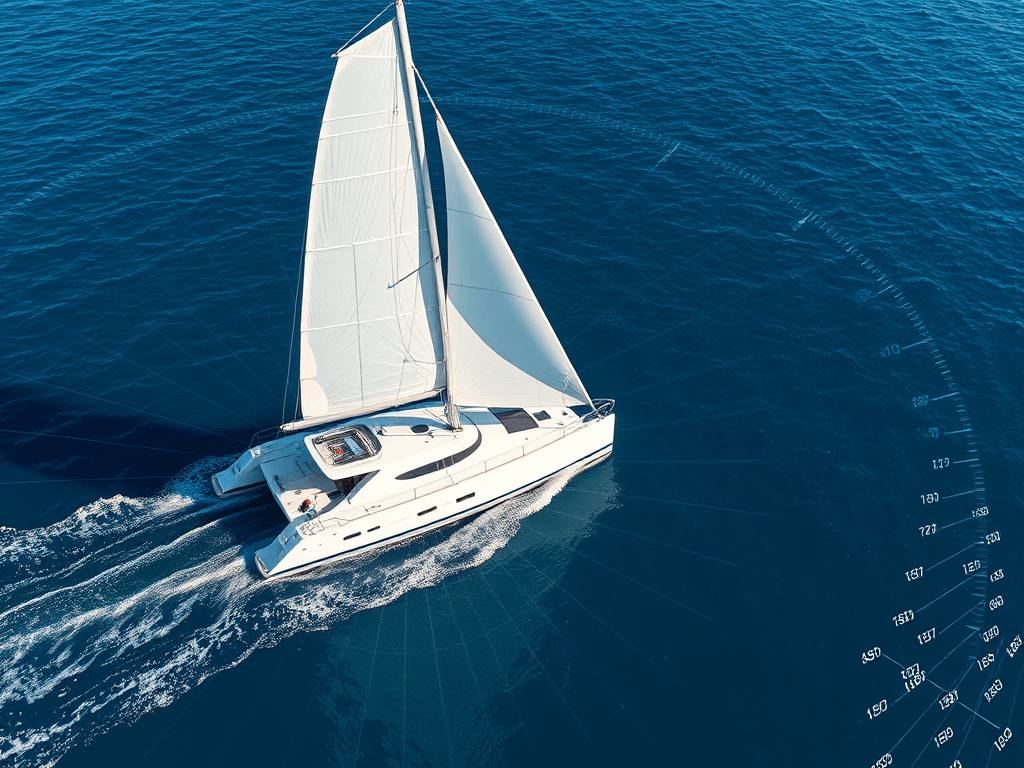
Now that we’re getting comfortable with our Excess 14, I’ve been wanting to better understand the expected polars for the stock main and jib. This will be even more interesting as we get our North Sails Code 0 and Gennaker in the coming weeks.
We found the below Polar table from the My Excess owners site, but it left more questions as polar tables are new to me. I figured it might be new to others as there were a few quirks that made it more difficult to understand.
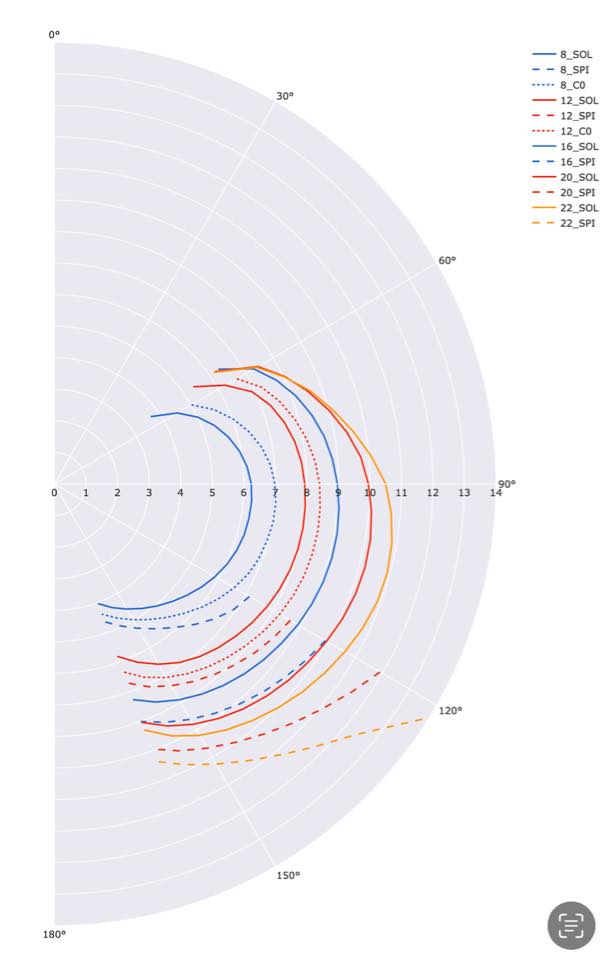
First, the polar tables are in French, so the table was a little more confusing, to me.
- Sol = Solent in French, which means Jib
- SPI = Spinnaker, but it assumes an Excess provided spinnaker? as opposed to shapes chosen by each owner.
- C0 = Code Zero – also up to the owner for the shape, if not using the stock.
- 8, 12, 16, 20, 22 are the TWS bands – note True Wind Speeds, not Apparent Wind Speeds.
- The degrees are True Wind Angle (TWA), not Apparent Wind Angle (AWA), which experienced folks will say, of course. To which I say, everything in boating becomes complicated, because… insert drinking story.
- A standard main is assumed, so the polars are related to headsails.
PredictWind DataHub
We’ve been using the Predict Wind DataHub to add more details to our polar capabilities and add more input to our sail planning. I’m still digesting my thoughts on how much value we’re getting out of the Professional PredictWind subscription, which is required to integrate our DataHub polars into our sail planning. It was $249 for 3 months, which is a significant commitment. Spoiler alert, it’s not clear the value is there, and possibly less obvious when sailing in the Mediterranean. I’ll writeup something as we have more experience with its usage.
The DataHub will generate polars for you, based on your actual sailing. It reads the NMEA 2000 instrumentation, outputting Apparent Wind Speed, Apparent Wind Angle, Speed over Ground and Course over Ground.
What it doesn’t do is know whether you’re on motor, (2 or 1 motors if we’re optimizing fuel), which sail we’re using, if we’re reefed, or if we’re just being lazy. As with most AI systems, PredictWind does a lot of inference and has this article for how motoring impacts it’s data generation. So, it’s not that it doesn’t incorporate assumptions of motoring, rather it doesn’t really know, and makes assumptions if your data isn’t within the range of the base model.
More reading on the DataHub configuration is here
With all those caveats, here’s what I am learning about the data we’ve collected thus far. The DataHub polars get more accurate over time. Here’s our initial Polar Tables, after first installing the DataHub. Not very impressive, and quite confusing.
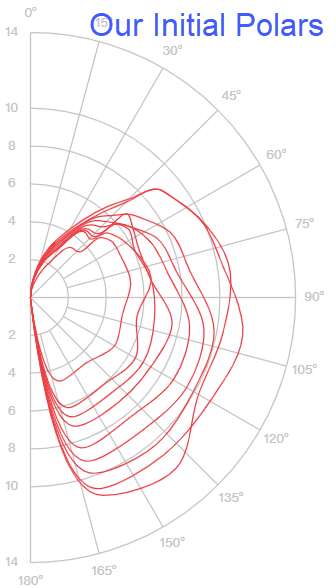
This set is complicated as we were sailing around Cyprus with limited winds, using engines, and limited experience with the boat. We’ve learned a lot how she sails and handles different winds, and when to reef.
Picking Specific DataSets
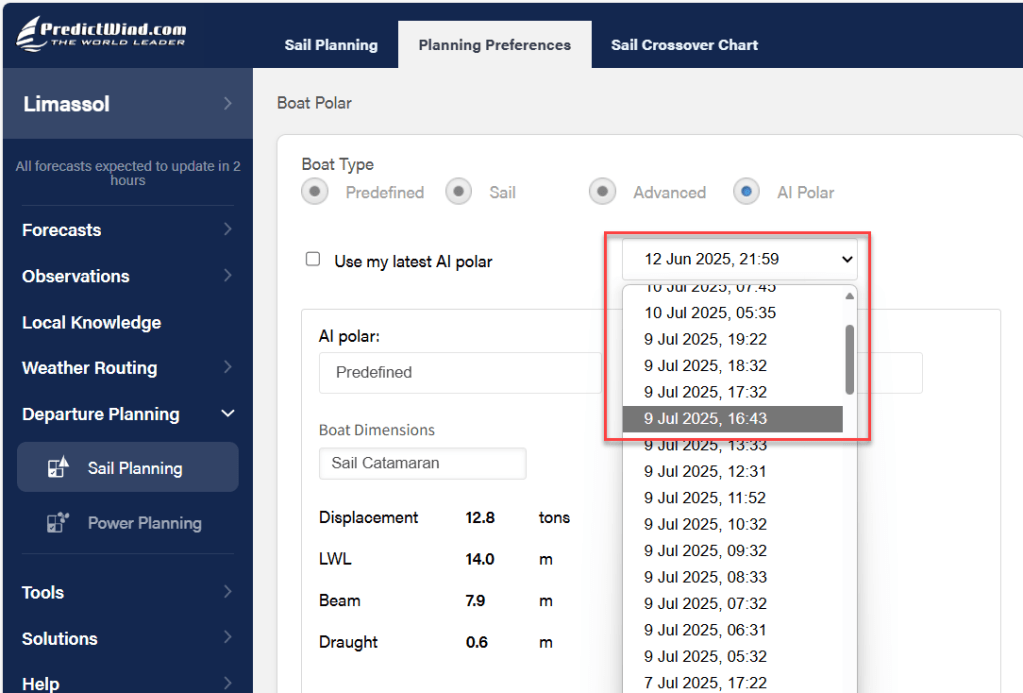
Within PredictWind Sail Planning Preferences, you can pick specific slices of polar data, which wasn’t as obvious at first, as you won’t have any datasets to choose from.
As an example, we had a long sail on July 9th, so we had lots to choose from, which could be used when you’re tracking which sail you’re flying. So this does get a bit more interesting.
Now that we’ve been continually sailing her for 5 weeks, here’s a comparison of the predefined polars that PredictWind uses, and what our most recent data shows.
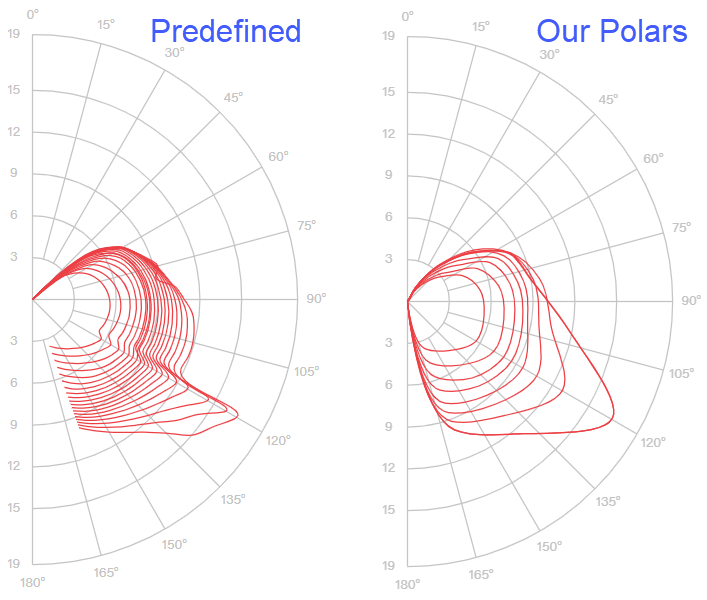
They don’t look too different. We currently only have the stock Elvstrom Main and JIb. Our North Sails Code 0 and Gennaker are “coming soon”, so I presume the sharp cutoff of the predefined polars at 120° is the inclusion of the Code 0 and Spinnaker, as opposed to us maxing out our Jib.
Also, keep in mind, these are True Wind Angle. For AWA, we’ve been able to sail fast from 40°-43° AWA, although the polar tables show trying to keep lines with the monohulls was futile, and I could have done even better if we zigged zagged a bit more. Remember, we’re still learning, as I’ve been racing friends’ monohulls, and this is our first catamaran ownership.
Tweaking Polar Tables
PredictWind and DataHub provide an advanced configuration, which is quite intimidating to tweak, so for now, I won’t. If we do find the Sail Planning feature valuable, perhaps we’ll invest more time. For now, we’re happy to understand what we should be achieving at various angles, although we’re already so impressed.
PredictWind DataHub First Impressions
Getting everything configured took quite a bit of time. The actual installation was relatively easy. Mount the hub (horizontally), mount the GPS antenna, if you really think you need it and find a NEMA cable to plug into the NEMA network. It would have been good to know it needed a NEMA cable or just include one as it’s useless without it.
The problem is the time it needed competed with all the other things we were absorbing as new boat owners. It was a least a full month of back and forth with support to get it associated with our boat. I made this a bit more complicated as I ordered the DataHub under a new account I was planning to use for the boat. But that made it difficult to associate with the existing personal account I had for PredictWind.
Some suggestions:
If you only have weekend time, I’d suggest waiting till you have a lot of dedicated time to configure, learn, and understand how DataHub and PredictWind planning all work.
While PredictWind support took 1-3 days to respond to each message, they were very helpful. So, incorporate patience into your budgeting of time and expectations.
These both conflict with the high pricing of the required professional subscription tier.
Excess 14 Observations
She’s a powerful and fast boat. As most Excess boats, we have the pulse rig, which adds 7m2 to the main sail, and 5m2 to the jib,. If we had the stock Code 0, we’d add another 14m2 compared to the standard Code 0.
Reef Early, is a standard saying. But, it’s not for just for safety. The main sail is soooo big, it starts to slow you down at 18kts AWS as it generates a lot of weather helm. We’ve started using Reef 1 around 18kts, instead of the recommended 23 and have seen about 2kts of additional speed. The huge main will comes in really handy at lower winds, and when we have a huge Code 0, it will be quite balanced. For upwind and beam sailing, it’s just a beast that looks great, but slows you down at decent Meltemi winds. So, the rule of look good (full main), isn’t quite as nice as looking really good flying by, or seeing an AIS reported speed of 9kts.
PJ, the owner of Hull #1 of the Excess 13 posted an awesome video, flying by a Bali, making it look like the Bali was dragging an anchor (full size fridge). Note, the video is limited to the Excess Catamaran Owners (and prospects), but image PJ sailing right by while the Bali just nods to the speed of the Excess.
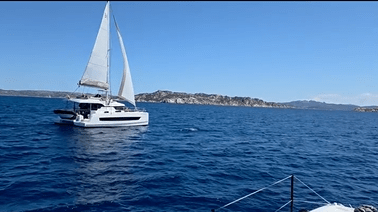
I’ll post more as I learn more. Suffice to say, there’s a lot of great data to observe, and I’m really enjoying this amazing Excess 14. With more understanding of the polar tables, we can continue to learn how to make the best of our sailing through the Mediterranean.
 Hull Yeah!
Leave a comment